
December 16 – 22
My “weeknotes” capture events, thoughts, and other items from the past week, mostly focused on work. Learn more about the weeknotes concept here.
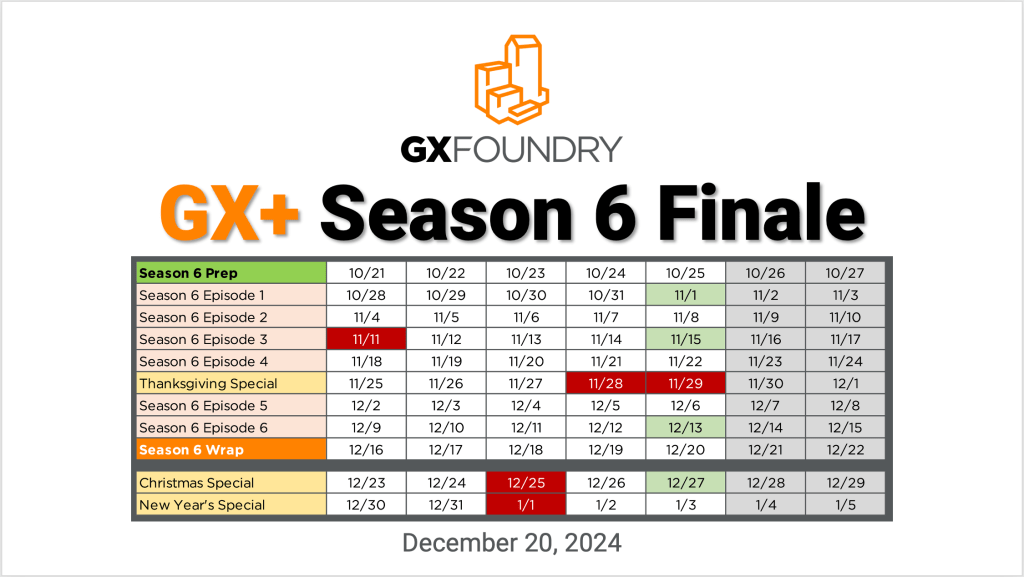
GX+ Season 6: It’s a wrap
We wrapped up Season 6 of the GX Foundry’s “seasons” model this week, and held our every-8-weeks “finale” event on Friday. In it, all three GX teams presented on the accomplishments of the past 8 weeks.
I won’t go into all those accomplishments here, as that’s a better topic for the GX Foundry blog, (and I don’t have the slide decks in front of me yet). But it was a good run this time around, with some hiring, a lot of meetings for the upcoming multi-agency website relaunch, some cool innovations around Quickbase, OnBase, DocuSign, SurveyMonkey, PlanetPress, and more.
With the 2 weeks of holiday slowdown upon us, I hope to get the decks from the teams and prep a post to the GX Foundry site shortly.
2025 Calendar Madness
I’ve mentioned my calendar in my weeknotes before, and it’s top of mind this particular week. Which, by the way, this past week looked like this on the calendar:

But with recent leadership changes and the arrival of 2025, it’s time to revamp my calendar. And this might be the roughest go of it I’ve had in my career. My calendar must accomodate:
- 8 WIP (Work In Progress) check-ins with direct reports; some weekly, some biweekly
- 8 PD (Professional Development) check-ins with direct reports, every 16 weeks
- I separated out WIP and PD discussions because having general 1:1 meetings that are supposed to cover both means you never end up actually digging into career stuff.
- 1 working session for Continuous Improvement efforts on a weird every-second-and-third-Tuesday in a 3-week rolling cycle
- 2 leadership check-ins with my boss (biweekly) and our CPO (monthly)
- About 16 team meetings of various types, some of which I host, some of which I attend, with a big mix of schedule cycles
- Free space to allow for ad hoc project and collaboration meetings
- Reserved time so I can get my own work done (LOL)
To get everything scheduled, I have to use a complex spreadsheet where I…
- List all the meetings I need to schedule (or are scheduled with me) on the left
- Create a “standard” bi-weekly calendar model on the right
- Map the individual calendar events onto the 2-week model to spot where I have conflicts and need to reschedule, etc.
The spreadsheet currently looks like this, as I work on 2025:

SIDE NOTE: I believe one of the reasons managers / leaders think everyone should return to the office is because our calendars are nearly 100% collaboration, and it’s way, waaaaay more effective to collaborate in person—in a room, with screens and whiteboards and so on—than to do it via any electronic means. That is, of course, a manager-centric bias, and is not necessarily what’s best for the organization.
In addition to creating the calendar events, sending invitations, including meeting rooms, ensuring there are Microsoft Teams features embedded, adding good descriptions of meeting goals, and so forth, I also need to figure out how agenda or work tracking will be done around those meetings. Do I need a Confluence space or page with agendas and tasks? Do I need a Jira project for tracking topics and discussion?
I’ve been at this work now for several days (intermittently), and I think I’ll finish this weekend. I’ll certainly finish before the Christmas holiday.
And then I’ll do it again in June.
Forging connections
I attended my first Atlassian user group meeting in Columbus this week. Why? Well… because one of our team members made a presentation on Atlassian Forge, and I wanted to see it. We’ve had a great run with Atlassian products since I brought them in-house in late 2020 (displacing ServiceNow).
But it wasn’t until Harrison came on board that our Atlassian efforts really, truly took off. And in this case, he was teaching other Atlassian admins — with many, many years of experience — about Forge. Great stuff.
Your goals, your organization’s goals, and knowing which is which
Oh man, was this a great podcast episode. It just spoke to me on several levels, and I hope it can do the same for others: How Do I Position Myself to Influence Senior Leadership? (51 min)
In this discussion consultant Muriel Wilkins talks with a guy who’s been trying to influence senior leaders on business strategy matters from his role as a leader of the IT function in his company (this already hits home). The discovery, through the conversation, is that he needs to figure out what his priorities are for his career and what he wants from work. Does it matter whether his insights and recommendations are heard? How much influence does he want to have and what is he willing to sacrifice to get it? What is his motivation, truly?
If you’re in a position where you are building influence but it’s not turning into real change, take a listen. It’s crucial to know your own goals and what trade-offs you’re willing to make to achieve them. Burnout is a factor, too.
AI can be efficiently wrong, but can it be effective?
Nice piece I read this week, talking about how folks of the DOGE persuasion are likely to promote using Artificial Intelligence (AI) to solve all manner of government problems. And why not? It sounds awesome:
AI fits this project all too well. It promises quick solutions to complicated problems. It is sold as a way to replace government staff, make the remaining staff more productive, and make decisions about what services will be available to the public and on what terms. Its use is largely unrestrained by laws. And, with its veneer of sophistication, AI inspires unwarranted deference to its decisions.
There have been several commentators lately noting there is a big difference between efficiency and effectiveness. We want government services to be efficient and effective, but we mostly want them to be effective. Efficiency is nice, but effective wins the day. And AI might be good at language processing efficiency, but that doesn’t mean it’s effective.
Recommended Reading: AI Can’t Solve Government Waste – and May Hurt Vulnerable Americans
PowerPoint Karaoke 2024

I hosted our second (apparently annual) PowerPoint Karaoke event this week, and it was hilarious. I wish I could share the video here, but we didn’t ask everyone whether it was okay to share publicly, so I’ll keep it private (dang!).
We had 6 presenters, 3 judges, and handed out 5 awards:
- Best Poker Face
- The “What Just Happened?” Award
- The Transition Whisperer
- The “Dear Leader” Award
- BEST IN SHOW
I’m thinking next year we do it in person, if possible. It’s funny on Teams. But live in an auditorium? That would be uproarious.
Public cloud was never the answer to all your problems
This isn’t a new insight or a new story, but I did see a new video this weekend that discussed GEICO’s recent announcement that they were “repatriating” a good portion of their compute and storage workloads into on-premises (or at least colocated) systems.
This video is a fairly good (if a little long) review of what’s changing and why. The eye-opening numbers were that GEICO expects to save about 50% on compute costs and about 60% on storage costs by regaining direct ownership of big parts of their infrastructure.
37signals has talked a lot about this in the last couple years, among others. And I’m here for it. All the sales people from Microsoft and Amazon that have come at me over the years (not to mention mid-level leaders) claiming that Cloud was the answer to all our prayers… ugh. The numbers never worked except in cases where the workloads meet a short list of criteria, like being particularly “bursty” or cyclical in intensity, or you needed access to experimental stuff that for whatever reason you couldn’t build economically or quickly in-house.
Here’s to the folks at GEICO (and others) that know how to build a spreadsheet.
Honorable mentions
Okay, turns out this week was busier than I thought, so here are a couple other things that happened I should mention, but I won’t go into details…
- Had lunch with an IT leader from a peer organization to talk shop, and he put me onto a possible professional development opportunity that involves AI. Us IT people need to stick together—I wish there were more lunches like this.
- Attended Keith Wilson‘s hiring / talent webinar this week (but had to cut out early due to a meeting conflict). Everyone in #govtech should be using the USDR Talent Toolkit to guide hiring practices of all kinds.
- Our teams mostly completed the infrastructure overhaul for one of the county’s agencies, bringing their IT under our management.
- We learned a batch of new construction / remodeling projects are hitting in 2025, so we had some preliminary chats this week to get our project management resources ready for the onslaught. I’ve always heard hospitals and airports are always under construction. But I think you can add government facilities to that list, too.
Discover more from digitalpolity.com
Subscribe to get the latest posts sent to your email.
 digitalpolity.com