
July 7 – 13
My weeknotes capture events, thoughts, and other items from the past week, typically focused on work. Learn more about weeknotes here.
Professional weeknotes
- Had a great conversation this week with the leadership team about ways we can improve tracking projects across the organization. Sadly, it will lead to me doing a lot of extra work to create some training for all the not-yet-aligned managers and teams. They will join the rest of the organization in using the Atlassian platform to track notable work on a weekly basis (in what used to be called “Atlas”). Training will be delivered at the start of August, and all teams will be required to be in the flow of weekly reporting by early September.
- We met with a handful of folks from “county administration” (which isn’t an entirely accurate descriptor, given the fragmented structure of the county) to make a pitch for expanded funding for our “One Franklin County” team. The OFC team is driving the migration of old websites to our new unified platform and upgraded content. We need more staffing support and some new and expanded tools as well. With the county cutting 2026 budgets it’s a tough ask. But without the added support, our efforts will slow to a crawl. Next steps are unclear, but hopefully we get a chance to make the case again.
- Got to know one of our new team members more this week as part of a professional development discussion. This year I started separating generalized 1:1 meetings from development-focused meetings. It’s made a big difference because now we have specific times each year when we talk long-range and the rest of the time is either short-range or whatever my colleagues want to discuss. I recommend everyone take that approach—keep long-term career / professional development discussions completely separate from day-to-day 1:1 talks.
- This was the last week for The Phoenix Project book club. We had a very nice final session and there was universal agreement that everyone in the organization should read the book. Who should organize that? Well… that’s less clear. But if folks want to take on the challenge, I have study guides and suggested questions to share.
- We’re still hammering out some of the handoffs in our “CAD” (Consult, Analyze, Deliver) model that helps us handle incoming work and projects and manage the flow of efforts across teams. But we had some good talks this week, so it feels like we’re making progress. We do still need to present on CAD to some of the other managers out there, though—some folks still don’t get it.
- We’re less than a week away from presenting an infrastructure proposal to our law enforcement colleagues and it’s fascinating to see how folks process things and prep them to share with others. Awareness of audience needs is so crucial, and yet it’s not something most folks learn to anticipate and target. I’ll be working with the team a little next week to sharpen the presentation and message. Truth is, this project will be worth nearly $3M if funded properly, so we’ll be presenting the “case” for this project to multiple audiences over time, and each audience needs something different. There are the guys doing the work that will receive the new gear. There are the folks that guard the cash and will want to know why this stuff is needed and why it’s so expensive. The messages have to be tailored. I’m not sure how I learned this in the past, but I did. Now I’m teaching it.
GX Foundry 2.0 Exploration

On Friday, July 11 I hosted an all-day in-office event for anyone in the GX Foundry that wanted to join. It was completely optional. And we discussed a lot of stuff. The goal was to set the stage for a refresh or re-imagining of who the GX Foundry is and what we do. We’re 2-3 years into this experiment, and it’s time to do a little reset. Example topics included:
- A deep-dive into results from a GX team survey that asked 9 questions about our culture, our mission, our leadership, and more (we had 12 replies out of 16 people)
- A review of the political and financial “environments” affecting our future, including federal, State, and local funding and regulatory matters, as well as technology opportunities like AI, vibe coding, low-code/no-code, etc.
- A look back at our “1.0” mission statement: “We forge digital experiences to build trust in Franklin County” and how it stacks up against the environmental factors noted above and how it stacks up against what we’ve learned in the last 2-3 years
- We watched the infamous Autonomy, Mastery, and Purpose video from Daniel Pink, exploring whether that might power some portion of our mission
- We also watched Simon Sinek explain the Law of Diffusion of Innovations, which applies to us since we’re working with agencies and leaders across the county that may not actually care about innovation—so how do we find the early adopters?
- We then did a large brainstorming session on what might become Mission 2.0 for us.
But the breakthrough of the day wasn’t the mission talk. It was around our culture.
Attitude adjustments needed
One of the key findings from the team survey was that staff are deeply concerned about the sense that our leaders spend too much time approaching situations from a place of negativity. I was surprised (but encouraged!) that staff were willing to share this in the survey. But I knew this was a problem based on some recent conversations. And I see it, too.
Indeed, I see it in myself. Too often.
For years I have rationalized this from my own perspective—that yes, I take a critical eye to situations and voice my criticisms, but then I flip a switch in my head and move forward in either a fixing mode or just letting it go. That negativity doesn’t actually consume me. I move forward even if I have critical things to say.
However, that’s not what others see. They see the negative comments, but they do not see the mental switch-flipping I do, because the former is shocking and the latter is invisible. This is doubly true because I’m in a leadership position. Everything I say or do is watched and gets amplified in the culture. (I shouldn’t have this much influence, but that’s the nature of teams and organizations, so it’s not something I can control.)
Leading from vulnerability
As part of the survey results discussion, I posed a question to the GX team in attendance: Of all the themes found in the survey, which challenge should be fixed first? They voted on 6 different themes. And the number 1 problem to fix? The negativity coming from leaders.
I didn’t know that’s how they would vote, but I suspected. Recent conversations had clued me in to the depth and breadth of the problem. Even before the survey I began to realize we—and I—had a problem to solve. I hinted at this last week when I mentioned the “Do you want to be right? Or do you want to be effective?” pair of questions I picked up from Scott Galloway.
Indeed, I had already taken the graphic I created and had little magnetic badges made so I could hand them out to the team. I prepped the slide below, shared my regrets, handed out the magnetic badges, and began to take responsibility for the damage done:
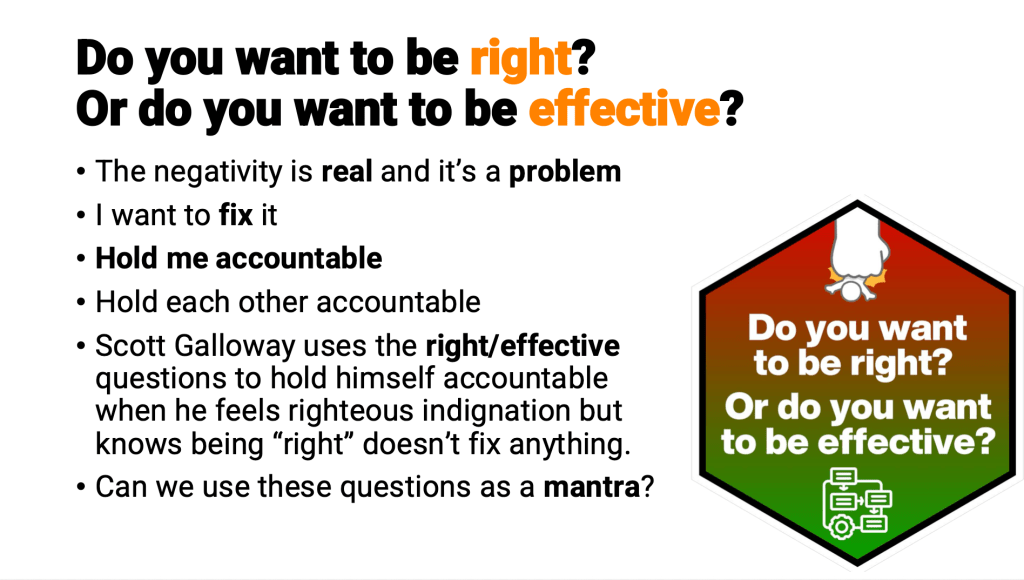
This was tough to do. I couldn’t point fingers. I couldn’t deflect the blame or explain it away. When asked, the team identified a handful of problems to fix, and when asked which of those problems was the biggest of all, the negativity was number one.
So I took ownership, agreed it was a problem, and posed the idea that we begin to use this “Do you want to be right / effective” question pairing to begin to dismantle the culture of negativity that staff perceive around them. I have asked staff to correct me, correct the other leaders, and thereby help us build the culture we want, not one we just suffer through without thinking.
Can correcting your team culture be fun?
You know what was surprising? Talking about all this, being vulnerable, and accepting the team’s frustrations at face value—and committing to fix it—released a lot of tension in the room. We even had some cheeky fun with the right/effective question and the little magnetic badges anytime someone would start going negative.
I know I will need to be reminded of how I show up for the team from time to time, and I’m really hoping I get this right / effective mantra thrown in my face—ideally when I least expect it, and in front of others!
We have some challenging times ahead, with budget cuts at all layers of government and increased workloads coming from the new requirements designed to block residents from accessing services they need. It would be very, very easy to go negative and bitch about the barriers and setbacks and struggles.
But we’re smart, capable, and dedicated to making things better. And that’s far better than just giving up. We can do some good in this world yet.
Professional links
I only have one piece to share this week, and it’s related to the re-thinking we’re doing with the GX Foundry team. It’s from Jennifer Pahlka (again) and her continuing work to influence governments to adopt better practices for digital services.
While the piece is focused on the federal level, it applies down at the local level, too (with some minor modifications). Highly recommended: The product operating model: How government should deliver digital services
Personal weeknotes
For the first time in perhaps a month I got a weekend without feeling like I was handling a family emergency. So that was relaxing.

Meanwhile, a breakthrough: My father has agreed to move into an assisted living situation (in August), which will help he and my mother find some support as they handle Mom’s dementia and just have the challenges of daily life mostly taken away (cooking, cleaning, personal care, etc.). All of us in the kids’ generation are relieved. Now we just have to make it real next month.
And another achievement: getting my parents’ cat Noah situated in our home. He made it to the vet this week for a check up (all good except for being obese), and he’s been pretty chill.
This next week we will get the pets acclimated to one another and hopefully get everyone integrated without any fights or territorial behaviors.
And in the midst of all that we continue to plan for a 40-mile hike in Northern California in late September and then a 170-mile hike in Portugal and Spain in April/May 2026 (the Camino Portuguese). I think we’ve got the gear assembled now and can start practicing with the packs and so forth.
Plus, I’ve added a 360-degree action camera to my gadget collection, in the hopes of documenting the journeys to come. I may even try my hand at vlogging on professional topics, as recently suggested by a colleague. I dunno. I don’t really like being on camera. But video does seem to be popular, if you can do it well. We’ll see.
About this week’s header photo

Discover more from digitalpolity.com
Subscribe to get the latest posts sent to your email.
 digitalpolity.com