

October 28 – November 3
My “weeknotes” capture events, thoughts, and other items from the past week, mostly focused on work. Learn more about the weeknotes concept here.
One Thought
Show your work
As we approach the end of one year and start of another, we’re entering “audit time,” where auditors in State government come along and check up on us little people in local government. Audits confirm that we’re doing what we say we’re doing across several dimensions—that we’re handling money appropriately, that we’re protecting data sufficiently, and so forth. It’s part of good governance, and I support it. Mostly.
Where my support wavers is when the auditors bring an incomplete perspective to the process, often over-focusing on rigid adherence to paper-based proof-of-work that started decades ago and has not been modernized. It feels like there’s a general lack of understanding that a system with a lot of old, rigid rules can be “gamed” even more than a system with insufficient rules. One can “study for the test,” get all the right answers, and still not know anything.
Still, a periodic self-reflection is generally a good thing, and the audit process allows us a brief period each year to honestly assess whether we’re doing what we should be doing, and whether we’re really doing it well.

We have policies for this?
This year I’m interested in our audit in a new way because I’m now leading a team I haven’t led before, and it turns out they have their own policies that gets audited each year. Specifically, we have a “Project Management Policy” and the auditors check up on how we’re performing against that policy.
I’ve known about project management training and certifications and all the written artifacts you can create in the PM space. But a policy? In an organization of under 100 people and a small PM team that has seen a staff turnover rate of greater than 100% in the last 5 years? Oh boy.
I’m not saying we can’t have policies, but in an organization of very low process maturity, unpredictable project loads, and high turnover in both staffing and tooling… yeah, that has to be a pretty fluid policy. And of course the written policy we have is:
- rigid
- overly prescriptive and focused on documentation over outcomes
- unaware of Agile methodologies
- ignorant of cross-currents generated by leaders reshuffling priorities for political gain
An anti-policy policy
So I’m left with the task to (quickly) generate an all-new policy that allows extreme flexibility while still holding ourselves accountable for delivering some semblance of a predictable project management service. I have to incorporate new tools, new methods, new documentation types, and a primer for our audit colleagues so they can follow what we’ve done and why. And it has to be instantly usable by our team. *deep breath*
We need a “policy” loose enough to allow for the extreme unpredictability of an organization that changes focus at the drop of a hat and allows us to change our tools (because we’re in the midst of doing that now). I’m really developing a set of guidelines rather than a formal policy. Maybe it’s a framework.
For now, I’m drafting the replacement policy with the goal of surviving the upcoming audit. But if it’s good enough to share—if it might help other small teams with their project management policy needs—I can share it here and on LinkedIn. Wish me luck.
Five Notes
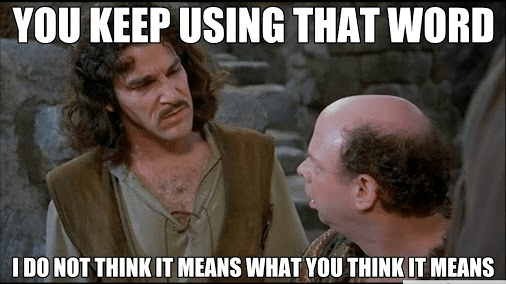
- In a few meetings and chats recently, I was reminded of how we all come from different backgrounds and bring different vocabularies to the table, and how English is such a great language because it picks up all kinds of new stuff all the time.
- In one meeting I used the work “grok” and got some quizzical looks. I thought the word was widely known, but it turns out it was introduced in a Heinlein novel in 1961, and I knew it because it’s been popular in tech circles for decades.
- Then in another meeting a colleague used the term “Machiavellian” and he got some blank stares. To me, that was a term I learned in high school, and I even read The Prince back then.
- Finally, I was lost when someone used the phrase “going ham” to refer to a leader that was pushing their team very hard in a meeting to produce results. I had to ask what that was all about, because I was thinking Honeybaked was somehow involved.
- Our project management team is in the process of adopting Atlas for high-level project tracking and updates. This will likely “go wide” in the organization, with any sizable work effort getting a name and being tracked in Atlas, regardless of whether the person leading the effort is a formal PM. We’ve enjoyed the radically simplified project views it generates—the constraints on updates are liberating, and it will hopefully keep exec-level people informed without being overwhelmed.
- Hiring for our 2 open positions has taken off like a rocket. We’ve gotten too many really great candidates, but hiring manager Sarah Gray is combing through resumes, phone calls, and interviews at a rapid pace. I continue to be impressed with the talent we’re seeing out there, and I wish we could hire so many more of these awesome people.
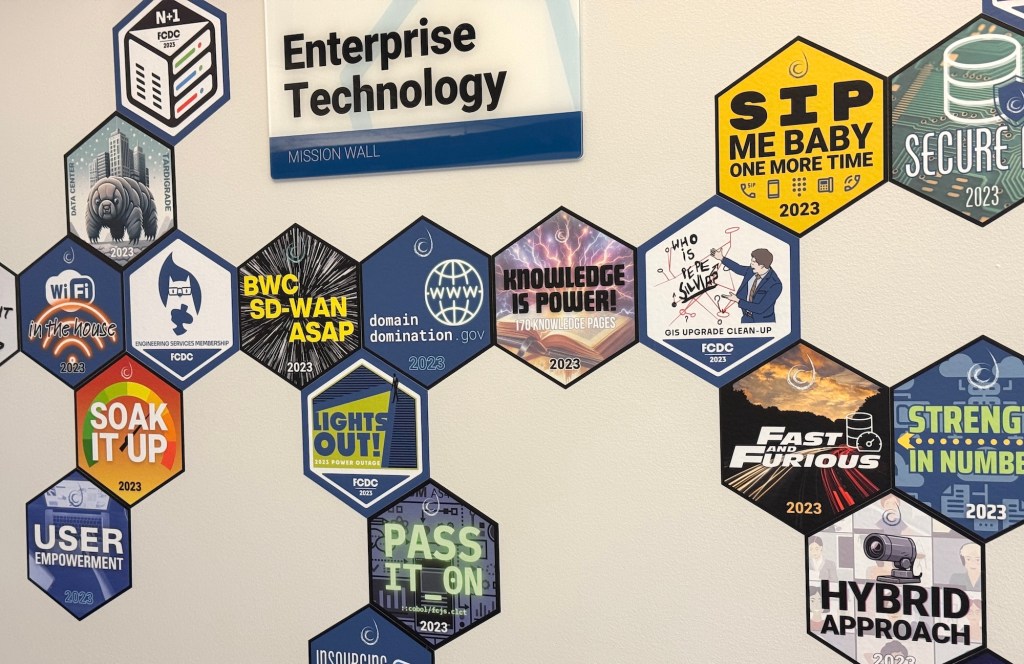
- The mission patch recognition program I set into motion early this year has taken on a life of its own. Our newest HR team member Kimberly Carroll is now running with the ball and doing some really great work. Often when I hand off a project or a service I’m nervous—unsure of whether the person or team I’m handing it to will really take care of it and make it work. But in this case Kim has taken the fledgling recognition program to the next level. She built a small team that is generating awards and patches with a speed of level of quality I hadn’t anticipated. Stoked to see the next batch of awards hit the street on December 5.
- I’m helping out with some high-profile projects right now, to help ensure they get across the finish line quickly and completely. In getting involved this way, I’m reminded of a phrase people hear me say a lot: “Everybody wants to go to the party; nobody wants to throw the party.” Running projects well is tough. When done well, it looks effortless. But the most effortless-looking projects actually take the most work.
One Video
The reboot of the old @midnight show as @fter Midnight has been pretty delightful. The format has been updated and expanded, and comedian Taylor Tomlinson has done a great job bringing a new voice to the format. The old 30-minute format was definitely faster-paced, almost frenetic at times, but the new 60-minute format is definitely more creative and takes more risks. It’s also incorporated all the changes that have hit the social media sphere in recent years, including sharing whole show segments to YouTube.
Anyhoo… here’s an @after midnight take on anxiety around the election:
Five Laughs


One Photo
Discover more from digitalpolity.com
Subscribe to get the latest posts sent to your email.
 digitalpolity.com