

May 19 – 25
My weeknotes capture events, thoughts, and other items from the past week, typically focused on work. Learn more about weeknotes here.
Back in the saddle (ouch)
This week I was back at work, but it was still an odd week (and next week is odd, too). Short-ish version of the week:
- I spent 3 days in 2026 budget meetings, going over continuing, revised, and new budget items in terms of software, hardware, services, and staffing. Kinda excruciating because we did it for the entire organization. But it’s generally better for us to do it together because when we do it separately, strange things start to happen as back-room priorities are set but not communicated. That still happens, even in a unified approach, but it happens a lot less.
- 2026 will be a tough year financially for the county due to a variety of factors. There are definitely impacts coming from federal funding problems caused by the Trump administration, but my understanding is most of the budget constraints affecting our operation are being caused by elected leaders who spent one-time COVID-19 and infrastructure funding as if those were permanent budget increases. Any “Nonprofit Budgeting 101” class will tell you one basic fact: “If you get a grant, it’s not an increase to your operating funds, so when the grant ends, the program ends if you didn’t find new funding in the meantime.” Politicians want the splashy press release when starting a program, but they don’t want to issue a press release that a program is canceled. So rather than cancel all the unfunded new programs, it would appear the plan is to degrade all the legacy programs. Same $2B, just spread thinner and thinner. So far, nobody loses their job on our teams, but it remains to be seen whether we can expect an annual increase, or can offer raises or promotions in 2026.
- Do departures happen in threes? I learned of yet another leadership departure this week, marking the third since the start of 2026. We’ve had 2 defections from the Security team (not terribly surprising—that’s a hot market) and 1 from our infrastructure operation. All were for perfectly reasonable career and family reasons. In a team of 100, that’s only 3%, so it’s not catastrophic. But 2 were managers and 1 was an executive, so it feels more impactful. Are there more shoes to drop? No idea. (But not worried.)
- Two interviews, one hire. I was included in two final-round interviews this week for our new Communications role (not under me). We made an offer and are expecting the new person to start in just under a month. Looking forward to seeing some communications-oriented help around here. We do good work, but we don’t do a good story of explaining ourselves. (Which is typical for technology orgs.)
- I missed our Phoenix Project book club this week, which was a bummer. Interviews and the next item got in the way. Two more sessions to go. But I did hear a parallel session started by one of my managers got going and it was a good start, too. The book really does work for a lot of different roles really well.
- I attended the second AI-focused multi-month class (and student project) hosted by the Partnership for Public Service. I have mixed feelings on this class. The content is… okay? It swings wildly from deep-in-the-weeds to way too shallow and basic. Right now I’m debating whether I stick with the class or not. I do want to do a project, however, so I may stick with it just for the outside eyes to comment on my work. More on the AI situation below.
- We completed our first full week on the new franklincountyohio.gov website, which seems to have gone fairly well. Interestingly, we’re still getting a lot of solid feedback from the public, which is generating some unexpected (good) friction. We are discovering we need t more organized approach to handling the feedback and responding to it in a productive (and not distracted) way. The GX Concourse team has some good ideas on what to do next.
- Friday was a catch-up day, as I talked to 5 different direct reports, hearing about their work, talking priorities, and so forth.
- The weekend was, thankfully, a holiday weekend. So Saturday was relaxed, as was Sunday. And I even have this weekend off from recording my show for the radio reading service. All I want to do at this point is just survive the coming week and get to June 1.
Why does the Code for America Summit need a celebrity speaker?
Speaking of surviving the week… I start with the holiday Monday, then a day at the office Tuesday, and then it’s off to Code for America Summit in Washington, DC with 3 of my colleagues on Wednesday. Should be an inspiring and educational adventure.
But I have one minor beef with the conference.
Why are their “keynote” speakers celebrities rather than people actively working in our field, doing interesting work? This is an industry conference, for digital government types, and we’re all there to learn from one another and celebrate the good work done (despite the destructive forces working through DC at this time).
This year’s keynote is by Chef José Andrés, from World Central Kitchen. He’s an impressive guy with a stunning international peacekeeping and philanthropic record. His humanitarian work puts us all to shame, quite honestly. But… he doesn’t work in digital government development. I’m sure he’ll have inspirational comments and so forth. But that’s not why I go to the Code for America Summit.
Last year the Summit brought in tech journalist and podcaster Kara Swisher to speak (and promote her newly-released book). I enjoy Swisher (she’s entertaining), but… she doesn’t work in digital government, either.
Look, I get it. The conventional wisdom is you bring in a big name because odds are they will be a more inspirational (or more fun) speaker than most of the folks in your actual field. It’s true of just about every industry. But we’re in tech, and you can look at the keynotes offered by major tech companies as exemplars—all those presenters aren’t inspirational figures, yet they do quite well at delivering their message because they get professional coaching and practice.
A proposal for future conferences
- Do not bring in any more celebrity presenters. Instead, use the budget spent on headlining talent to…
- Find a handful of projects emblematic of our field and missions and work with the folks involved to polish the hell out of their presentations with professional editing of the visuals, professional coaching on presentation, and plenty of practice sessions to get it right. Follow the model of tech industry giants like Google, Meta, OpenAI, and Apple in prepping the keynotes.
This approach would make for better keynotes and would allow a handful of folks in our industry to develop national-conference-grade skills and experience in professional presenting, making future conferences better and “gifting” those involved with unique training and practice.
We love you, Chef Andrés. Thank you for your inspirational example. But I can watch you on YouTube. Code for America (and similar conferences) is the only chance I get to hear from my peers and leaders in my field. Let’s hear from them in the keynote.
Thinking 2025+ strategy
Something is coming. Not sure what. But I’m starting to think about revamping my approach to my role in the organization and in our broader local government. We have a team of good people, but we’re not firing on all cylinders, and despite the effort to define a mission for the GX Foundry, it feels like it’s half-baked. Or maybe half-right. There’s something more we need, and I feel like I’m just starting to develop the core of a broader or bigger vision. Although I will need input from others to build it.
Building trust in public services is still at the center of everything (because without that trust, local government can’t do anything meaningful in the community). But how we develop that trust—through modernizing interactions with digital service—feels like it’s just beyond our reach. Or that we may be able to make a difference through direct action, but the size of our team is so small we cannot make a broad enough impact to be truly meaningful.
It feels as though “capacity building” must be thrust toward the center of our mission. Yes, it’s digital. Yes it needs UX research, service design… it needs all the accoutrements of human-centered civic tech. But if we try to do it alone, if we try to boil the ocean—even one gallon at a time—we will fail. We must teach others to boil water, too. We must lead a local revolution.

This requires rethinking how we are structured and what skills we need on the team. We can’t succeed with a single coach and a single team of players. We need a lot more coaches and a lot more players. We need a league, not a team.
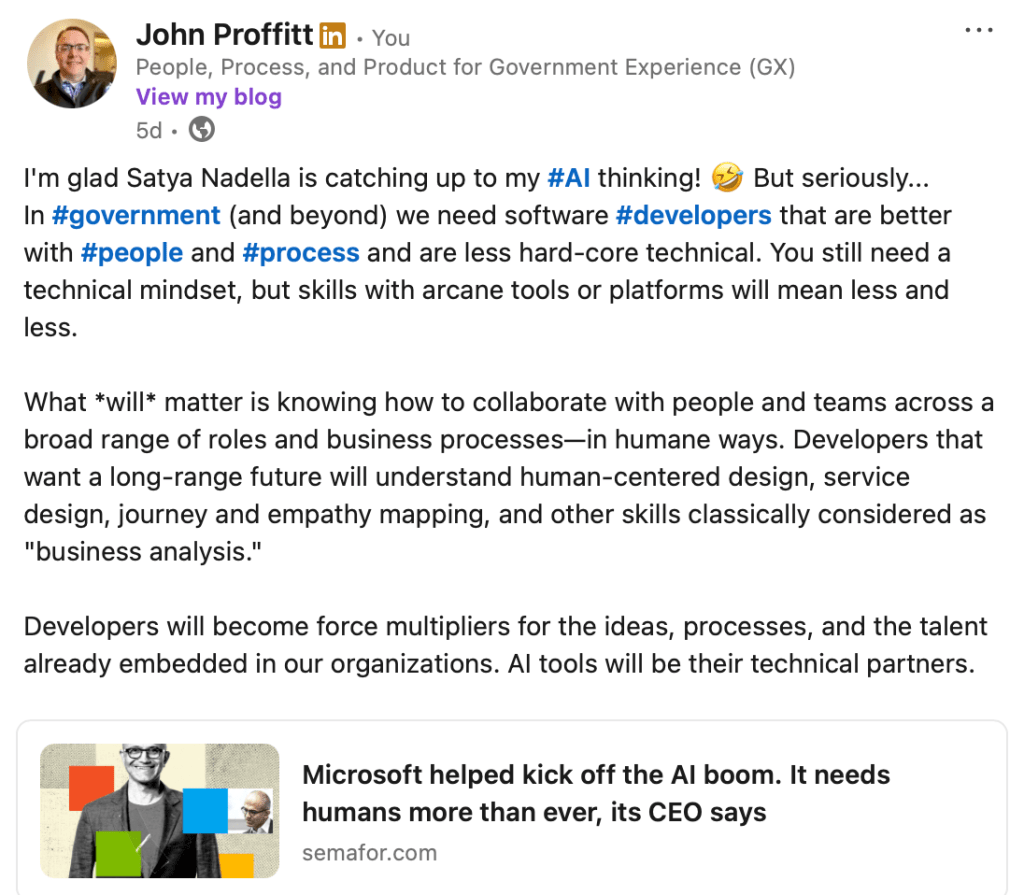
I already know one piece of the puzzle. We must build, lead, and curate a community of practice around low-code / no-code development that spans our local government, supporting responsible development of unique tools and solutions inside agencies and teams to speed up service delivery to the public or just improving productivity (so there’s more time for public service). We’re starting down that road this year.
Our new franklincountyohio.gov website was built with a nascent community of practice of communicators gathered from nearly 14 different agencies. So there something of a template.
But it’s more than just communities of practice. Amplifying digital capacity generally and human-centered design specifically will take new talents. And we haven’t yet completed developing talents like product ownership, and we’re a long way from effective service design.
So there’s more to be figured out. I will need more ideas, more input. But the time is coming soon for a revitalization of the GX Foundry concept, or perhaps something even bigger. I just need more time to think it through and talk it through.
Damn… AI is infiltrating my strategic thinking
Speaking of strategic thinking, there’s one thing that’s already clear to me: Artificial Intelligence (AI) will be in the mix of tools and methods we must to get out there into the hands of the most creative and responsible in local government. And at least where I am today, we haven’t even started yet. To date, we have zero policies, guidelines, or recommendations about AI tools on the books. It’s every employee for themselves out there.
Our lack of policy was actually intentional. We were concerned if we regulated or guided people too soon we might squelch some innovation. Further, there’s a lot of “AI” being injected into tools we already have, so if you block it or monitor it or regulate it, you already have a huge installed base to manage, and we’re just not ready. But we better get ready.
During our 2026 budget talks I proposed 1 new position to focus on developing AI strategies and methods of distribution across our local government agencies. While it hasn’t been formally shot down yet, I expect it will be, mostly because no one can envision what that person would do. In a budget crunch year, new stuff like this that’s a bit speculative or even innovative likely won’t get the nod.
Yet now is the time to bring in—or develop—AI talent in local government. Or at least it will be by 2026. Microsoft has started to release paid AI products into the government sector, OpenAI has announced some government-specific plays, and there’s been enough experimentation at the federal and state levels to start to see some nascent use cases that just might work for us.
And all that’s coming from me: a big AI “detractor” in these pages, on LinkedIn, and elsewhere. I’ve decried the hype cycle of it all (and that’s still going on) and continue to bemoan all the anthropomorphizing of these software tools. There’s no “thinking” going on, there’s no “reasoning” going on—those are just marketing terms intended to drive more usage and to encourage magical thinking about these tools and services.
Still… though it may pain me to say it, I have to admit it’s time to get serious about learning AI and finding where it can fit.

I still think the bulk of AI benefits will be captured as part of other software tools and services, embedded in processes and actions where the action model is well-documented and understood. We cannot use open-ended probabilistic AI platforms when it comes to calculating benefits or delivering life-and-death services. We’re not going to play Russian roulette with taxpayers or taxpayer dollars.
Still, there’s a growing body of use cases that can use the generative models and tweak them for non-mission-critical (yet still important) work. Check out the following video about a staff manager that uses LLM-based AIs extensively and even creates custom GPTs (that’s an OpenAI-specific term for an LLM interface that’s pre-loaded with a prompt and some limited data):
None of the elements in the video is specific to government work or government services, but it’s clear these tools—in the right hands—can save time, build content, and provide a functionally-tuned interaction model. It’s not earth-shattering. But the the demo happens very fast and shows what a little training and experimentation can enable.
At Code for America Summit next week, I full expect to see more examples of LLM-based AIs used to solve real problems for real local government teams.
We’re still in the early days, but the hype cycle is clearing a little, so now’s the time to start paying attention and get involved in envisioning the future.
Much to my chagrin. 😉
Great stuff from Jessica MacLeod
Over the past few weeks I’ve stumbled across a couple posts from consultant Jessica MacLeod that are right up the alley of civic tech leaders dealing with government bureaucracies in particular. Her latest this week was super-solid: How to Break Down Silos and Collaborate Across Government.
There’s a lot to commend this piece, but man, this particular quote just hit home super-hard (boldface added):
When I work with public sector teams, one of the first things I look for is how visible the work is. Can people across departments explain where things stand on a project today? Or what the context is behind a project? Do they know who’s accountable? Can they locate the latest draft of the work without digging through three email chains?
I’ve been fighting the Making Work Visible battle since I arrived in 2019. It continues. There’s a natural tendency to feel that meta-work is not real work. But in fact it is real work, and may even be more important than the hands-on work. Because it’s visible work that gets praise, funding, political support, prioritization, and other resources.
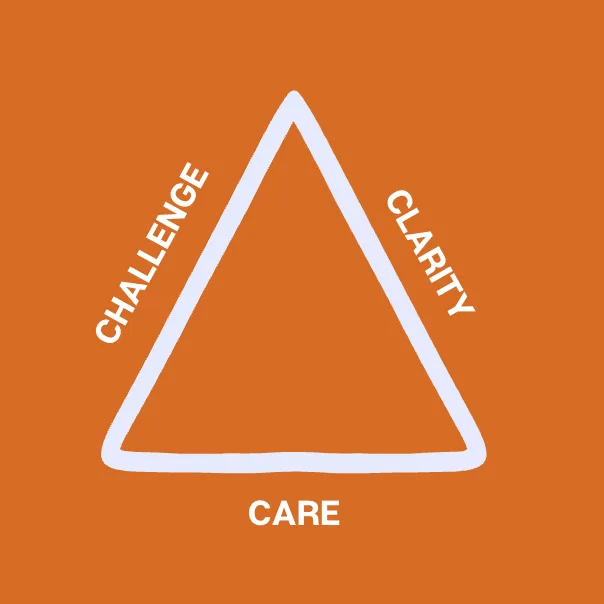
I also appreciated the concepts of Challenge, Clarity, and Care, which she explains in-depth and which reminds me a lot of the Radical Candor model (and book) published several years ago.
This was the second MacLeod piece I’ve admired in recent days. The prior one discussed Mark Lerner‘s experience as a leader (he’s now at Technologists for the Public Good, or TPG) in government. You can read that piece here: How Modern Government Teams Are Redesigning the Way Work Gets Done. The article includes 5 recommendations from Lerner:
- Pilot New Ways To Make Faster Decisions
- Be Ruthless About Open Collaboration
- Reward Follow-Through with Smart Visual Management Systems
- Make Room for Informal Communication
- Redefine What Failure Means
MacLeod is an instant subscribe for me. You can find her Substack here.
Principles for service orgs
Related to everything else above was this post on LinkedIn by Kate Tarling, shared into my feed by Neil Williams. In the post, Tarling recaps a talk she gave at an Agile conference in Manchester, which was a reprisal of content from her book The Service Organization. The book includes 12 principles for service orgs, and I know mine needs a refresher course on these models:
Deliver better services
- Work from the outside in
- Understand and use performance to improve services
- See policy and strategy as service delivery
- Use approaches that learn, test, iterate
- Arrange design and delivery of tech, data and infrastructure for better services
- Make the work understandable and visible
Develop the conditions to deliver better services
- Organise teams and work around services
- Do whole service leadership
- Shape investment and finance processes for better service delivery
- Evolve governance for services (not the other way around)
- Build and support service competency in house
- Develop and protect a people and service culture
You can get details on these excellent recommendations here. And get the book here.
About this week’s header photo

Discover more from digitalpolity.com
Subscribe to get the latest posts sent to your email.
 digitalpolity.com