

September 15 – 21
My weeknotes capture events, thoughts, and other items from the past week, often focused on work, but with personal stuff, too. Learn more about weeknotes.
I’m headed out for a short vacation this coming week (starting Tuesday), so my next weeknote will be pretty short. But this one is pretty long, to make up for it. 🙂
Professional weeknotes
- 1:1 sessions are back. After a longer-than-intended summer hiatus, all my 1:1 meetings with direct reports are back. That’s 6+ hours per week when you also include periodic career-focused conversations. Years later, I still don’t feel like I’ve mastered the art of the 1:1, but at least the time is there for us. I must admit, coming up through my career, I never had bosses that held regular 1:1 meetings with me—I wonder what I would have done with that kind of access?
- The migration to full Jira is afoot. I brought Jira Service Management into the organization in late 2020, displacing a half-finished ServiceNow implementation that had been around for 5 years and cost at least a couple million bucks in licensing, consulting, and staffing. Our first JSM bill was maybe $40K tops, saving tons of money. In the years since that first deployment, we’ve organically grown the footprint and this year we finally extended ourselves into the full Jira platform, enabling us to professionally evolve our work management / project management efforts across the organization. And this week marked the leap forward into this unified Jira solution for at least a couple teams. Long story short, all our teams and work are moving to Jira between now and the end of the year. Excited to see where this goes!
Squad goals
I’ve briefly shared in this space my interest in the “squad model” or “Spotify model” or “agency model” as a possible re-organizing principle for our digital services teams. Today we are mostly organized into functional or skills teams, and while it’s okay, it creates some silos and may be holding back our best efforts. So the thinking continues.
As part of that thinking, Sara Hall from CODE PA was willing to chat with us and share some insights from their use of squad models in their own work. I also collected some additional articles this week:
- Why Spotify Squads Are a Popular Failure for Product Teams
- The Case for Adopting a Product Operating Model
- How to Implement Agile Development Practices like Spotify
- A new operating model for a new world
Once I’m back from vacation, I’ll start mapping out some meetings to explore these ideas with managers, then with staff as well. Still not sure where we go from here. But the staff, during our summer culture review, asked for more strategic direction and a reduction of the “silos” within our teams (among other requests). So we need to think about changes of some kind, and some variation of the squad model may make a lot of sense for us.
The law of diffusion of squad model innovation
While we’re talking about the squad model, an interesting observation from this past week…
Currently we do weekly surveys with our GX Foundry team, assessing how our culture is doing, especially in monitoring “negativity” from leadership roles. (This was an insight from over the summer that staff called out, and we’re working to correct it.) One of the survey comments from the prior week was about the squad model itself as a concept, and whether we, the leaders, could actually pull it off.
Okay, fair question—I’m wondering about that, too! But the most important discovery was that the squad model came up at all with staff. This is a topic I’ve discussed here in my weeknotes, but it’s not an official topic at the office. (At least not yet.) I’ve held no meetings, sent no memos, made no presentations about this. So… why would staff be talking about this?
It suggests some of the staff are regularly reading my weeknotes. Kinda surprises me, really! It’s not like this is an official channel (it’s mine personally) and it’s not like my weeknotes are a riveting read. But hey, if folks want to follow along, that’s fine with me.
And this got me to thinking about leadership and cultural transformation and specifically the Law of Diffusion of Innovation. Without realizing it, I’ve enabled diffusion of innovation in this case, allowing early adopters to pick up on signals I’m sharing unofficially, long before anything becomes “official” or formal. So if you, as a staff member, want to see leadership thinking, ideas, and plans early, you can (so long as I keep providing weeknotes or something like them). No one is asked to read this stuff—it’s definitely not an assignment, and never will be.
Perhaps this is a leadership model that can be replicated? Or maybe I’m doing something that’s been done many times before? I don’t know! But I’m delighted to imagine what I’m doing fits into the diffusion-of-innovation concept, as described by Simon Sinek in this popular video:
Explaining vs. Exploring
Finally, one more note on culture development (and repairs) this week. And this one comes courtesy of training from Business of People, which our organization has invested in over the past couple years for folks in management roles and above.
In leading individuals and teams, in building culture, leaders (and anyone) can spend time explaining or exploring. Explaining is where you spend your energy justifying your decisions, telling people why you did what you did, defending yourself, or constantly trying to tell your compatriots how things work, how to think, what to perceive, and so forth. It’s a mode that typically shuts down conversation. It’s more broadcasting and less communicating.
By contrast, Exploring is where you ask more questions, when you deliberately guide the conversation into a place of discovery rather than rationalization or defense. It’s an open door vs. a closed door. It’s using a 2-way transceiver rather than a 1-way transmitter with your colleagues.
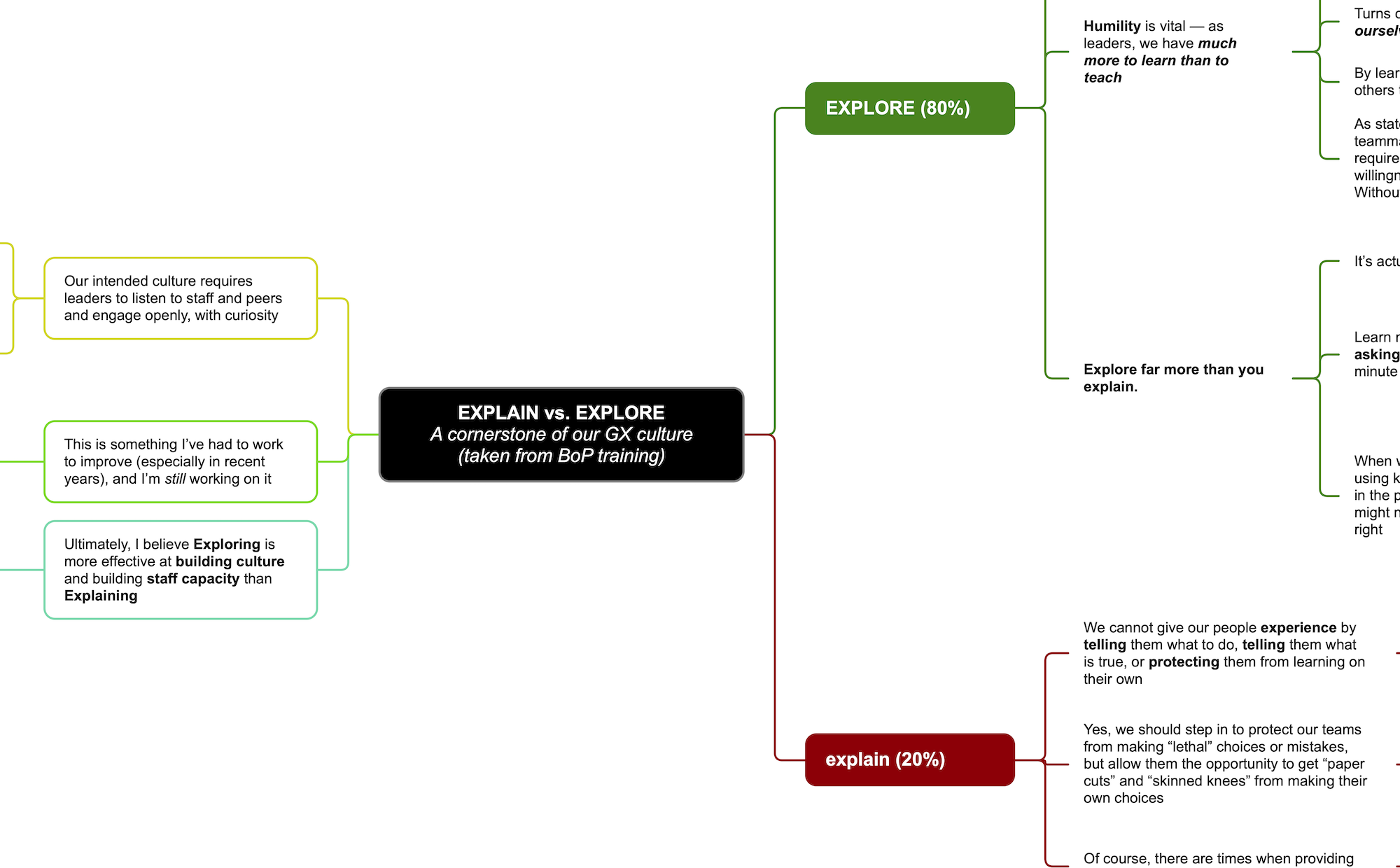
Every leader needs to do some explaining and some exploring. But ideally leaders will do much more exploring than explaining, because exploring is the more inviting and collaborative model and it encourages discovery and discussion—a key component to innovation, creativity, inclusion, and cultural transformation.
So as I thought (and talked) more about this explain / explore split this past week, I developed a mind map, shared it with my leadership team, and now I’m sharing it here for anyone interested. There’s a lot of stuff in there, and while it makes sense to me, it may mean less to folks that haven’t had the explain/explore training, or perhaps haven’t seen leaders that default to explaining (which can be very frustrating for colleagues and direct reports if it’s dominant).
If this mind map or these ideas help you in any way, I’d love to hear about it in the comments, or reach out to me via LinkedIn or other channels.
Professional Links
- Managing Your Team When the C-Suite Isn’t Providing Strategic Direction. This is a great piece from HBR and it can apply to so many teams in so many situations these days. As a member of our particular C-Suite, I’m sensitive to this kind of criticism (but if the shoe fits, as they say). Lord knows I have made this kind of critical assessment of my own in the past. And in our particular county government, this lack of strategic direction is a huge problem, driven primarily by the highly-federated nature of our political and financial structures. That is, there’s limited central leadership to assemble a strategy and spread it across a disparate range of agencies. But strategy can come from all kinds of organizational layers. Which is why I try to provide some version of it on my own, when I can.
- Over on LinkedIn, Jennifer Pahlka pointed to this post, which in turn referred to this new study out of Yale: Experienced state employees can deliver big savings on infrastructure. Turns out long-standing and highly-experienced engineers (the most expensive type!), actually save governments money. Why? Because they reach solutions faster, with fewer false starts, better results, and so forth. It makes logical sense if you just think about it a little. But of course the morons in DOGE or other “government is bad” types all think you cut the expensive, experienced folks and bring in cheap, low-experience workers instead. This is more than just offensive, it makes no sense on the numbers. (If you’d like the fully-detailed academic paper, it’s here.)
Personal weeknotes

- Multiple bites of the Apple. Every year this week comes—new iPhones are released, often with other updated gear. Yes, my wife and I got new orange iPhones on Friday, as well as new AirPods Pro 3, and I picked up the Apple Watch Ultra 3. I don’t drink, don’t smoke, don’t have other expensive habits, really, but this one gets me all the time. We’re excited to take the new cameras and the new AirPods with us to California this coming week!
- In the move from old iPhone to new, I tripped myself up by erasing my old phone (for trade-in) too soon. I hadn’t migrated my Microsoft Authenticator content over to the new phone yet. Then I really messed up—I initiated a password change, got distracted, and didn’t write down my new password. D’oh! So Microsoft locked me out and now I’m kinda screwed for a full month while I wait for Microsoft to execute an account reset, which they delay for 30 days. Their poor support options and shifting technology choices have really pissed me off. So I’ve started a move to Proton Authenticator instead. Maybe by October 22 I’ll have already moved away from Microsoft, never to return.
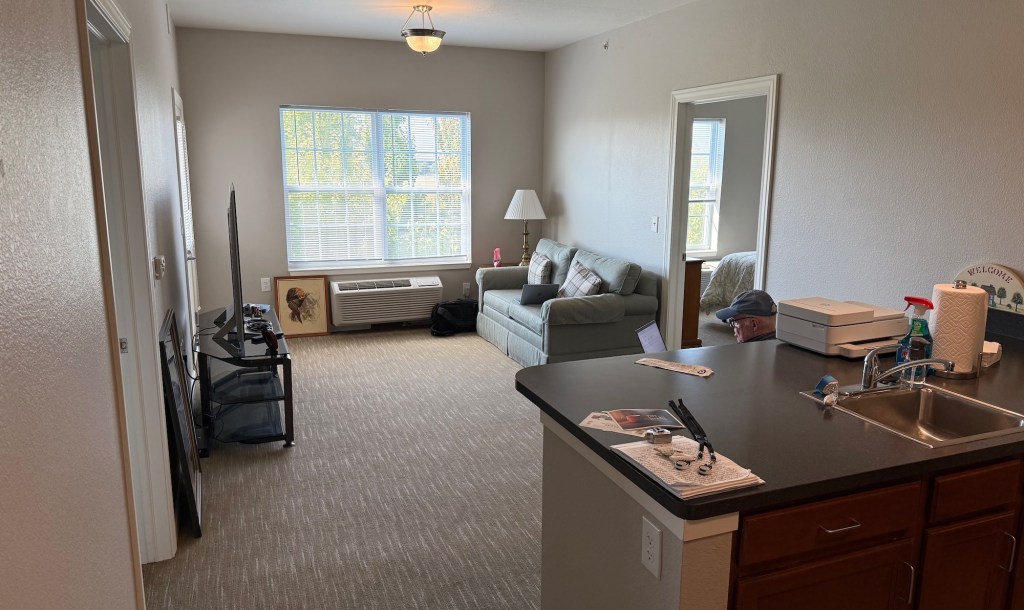
- Finally, the big effort this week was setting up a new assisted living apartment for my parents in the Toledo, Ohio area. We did this about 6 weeks ago in Tennessee, but that didn’t take (long story, and I’ve talked about it in the past). So we had movers go to Tennessee, pick up their stuff (again), and take it to Toledo. I proceeded to setup everything, including doing some shopping. I even had dinner with my parents in the assisted living dining room, which was perfectly fine. Our hopes and prayers are with them to move in and stay there. The programs outpace anything they can do at home, even with professional support. And my mother’s dementia is advancing. Indeed, I fielded a phone call on Saturday when she wanted confirmation that my father was in fact her husband.
Off to California

This coming week my wife and I are off to the Bay Area to complete a roughly 40-mile hike from Half Moon Bay to San Francisco itself, all along the California Coastal Trail. It’s urban and rural, along beaches and over mountains. It’s a “test” for us, to confirm we’re able to do the Camino de Santiago next spring, walking from Porto in Portugal up into Spain and ending at Santiago de Compostela.
For this trip we fly to SFO, use public transit to get to Half Moon Bay on the coast, then walk north over the next few days. No rental car. No Uber rides. We just walk. We’ll stay in local hotels and an Airbnb each night. Once we’re in San Francisco we’ll ride the Cable Car to our hotel, then hang out for a day before using transit again to get to the airport and fly home.
The goals? Test out our gear (clothing, shoes, backpacks, accessories). Confirm we can do multiple days of walking back-to-back while carrying everything we need on our backs. Ultimately we need to know whether we can repeat this kind of coastal trip in Portugal and Spain in April/May 2026, but next time walking over 170 miles rather than a mere 40. Oh, and I need time off work, too. Our last vacation in the spring was… not a good getaway for various reasons.
Watch out for photos in my next (short) weeknote release.
About this week’s header photo
Discover more from digitalpolity.com
Subscribe to get the latest posts sent to your email.
 digitalpolity.com